)

Time off work doesn’t always fit neatly into annual leave. You may need extra time for personal reasons, family commitments, study, or unexpected situations, so it helps to understand the different options available.
In the UK, not all time off is paid. Alongside annual leave and other entitlements, there are situations where you may need to take time away from work without pay. This could include anything from short-term emergencies to longer periods like a career break or time for personal development.
Because policies can vary between employers, it’s important to know what is typically offered and how to approach these requests professionally. This guide explains how unpaid leave works in general, when it might be used, and what to expect, helping you plan and manage time off with more confidence.
Disclaimer
This article is for general guidance only and is not a legal source. Policies can vary between employers, so always check your contract or speak to a professional for advice specific to your situation.
What is unpaid leave?
Unpaid leave is time off work where you do not receive your usual salary. Unlike paid leave (such as annual holiday or sick pay), this time is unpaid.
Statutory: In the UK, some types of unpaid leave are a legal right (known as statutory leave). For example, unpaid parental leave is granted by law, allowing eligible employees to take up to 18 weeks per child.
Discretionary: time off that is not required by law and is granted at your employer’s choice, such as unpaid holidays or a career break.
Unpaid leave in the UK can include:
Unpaid parental leave (up to 18 weeks per child)
Time off work for jury service or public duties
Emergency leave or unpaid compassionate leave
Medical appointments where no paid time is offered
Longer breaks, such as a career break or sabbatical leave.
Tip
Unpaid leave usually means you stay employed, but you won’t receive your normal salary. Some employee benefits, like pension contributions, may also be affected, so check your contract or speak to HR first.
How to request unpaid leave
When requesting unpaid leave, keep your professional letter to your employer clear and concise. A well-structured request that outlines key details and timings makes it easier for employers to review and respond.
Before asking for unpaid leave, start by checking your contract or company policy. This will help you understand what is available and whether you need to follow a formal process.
When making your request:
Give as much notice as possible to help your employer plan around your absence
Be clear and concise about your reason and the dates you need
Show awareness of your workload, including how tasks can be managed while you’re away
Follow internal procedures, such as submitting an application for an unpaid leave letter if required.
In some cases, employers may request that you use your paid holiday before agreeing to unpaid time off. If this happens, review your options and choose what works best for your situation. Check if you're entitled to paid leave and calculate your holiday entitlement to explore your options.
Tip
Some types of leave are protected by law, while others rely on your employer’s policy, so it’s important to check your contract before requesting time off.
Unpaid leave request letter
In some workplaces, you may need to submit a formal request when applying for time off without pay. An unpaid leave request letter should be brief and to the point; around 100 to 150 words is enough. You can also send an unpaid leave request by email.
Focus on key details such as your dates, reason (kept concise), and how your work will be managed. Keeping it clear and structured makes it easier for employers to review and respond quickly.
Include the following:
The dates and duration of your requested leave
A brief reason for your request
Any relevant details about your workload or handover
A polite and professional closing.
Example of an unpaid leave letter
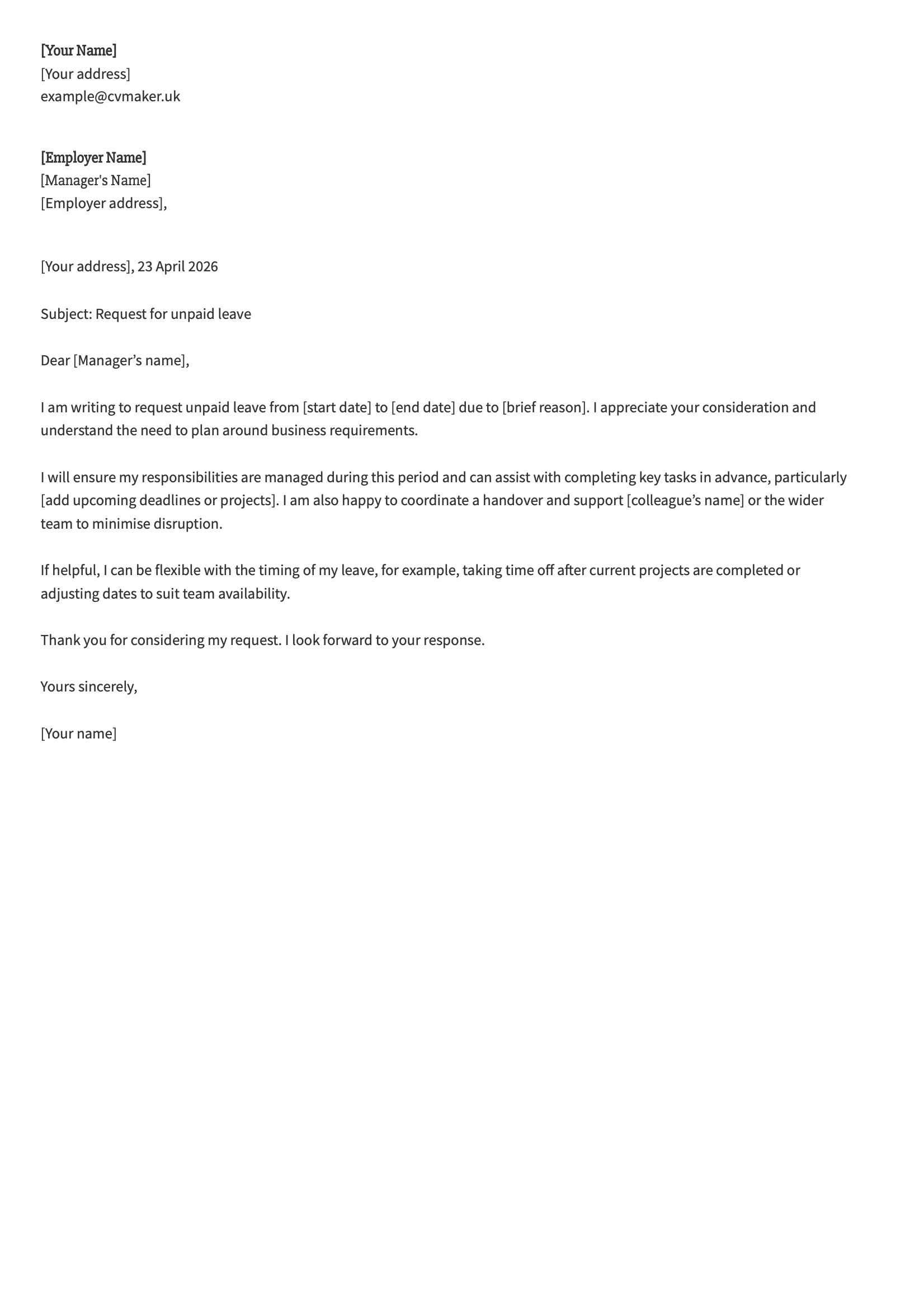 Download this unpaid leave letter in PDF or copy and paste the template below.
Unpaid leave letter template
[Date]
[Employee Name]
Employee Address]
[Manager’s Name]
[Company Name]
[Company Address]
Subject: Request for unpaid leave
Dear [Manager’s name],
I am writing to request unpaid leave from [start date] to [end date] due to [brief reason]. I appreciate your consideration and understand the need to plan around business requirements.
I will ensure my responsibilities are managed during this period and can assist with completing key tasks in advance, particularly [add upcoming deadlines or projects]. I am also happy to coordinate a handover and support [colleague’s name] or the wider team to minimise disruption.
If helpful, I can be flexible with the timing of my leave, for example, taking time off after current projects are completed or adjusting dates to suit team availability.
Thank you for considering my request. I look forward to your response.
Yours sincerely,
[Your name]
The Best CV Builder
Effortlessly create a professional CV
Easy to use on any device
Integrated spelling and grammar check
Customisable job-specific CV examples.
What are the different types of unpaid leave?
There are several types of unpaid leave in the UK, depending on your circumstances and employment rights when on leave.
Navigating family and parental leave in the UK
Taking time off for family reasons is common, and there are different options depending on your situation. One key option is unpaid parental leave, which allows eligible employees to take up to 18 weeks per child, usually in blocks of up to 4 weeks per year.
Understanding how options like shared parental leave work alongside other types of leave can help you plan time off work more effectively, especially for childcare or longer-term family needs. Explore our guidance on maternity leave and paternity leave to learn about the key differences.
Handling emergencies and caring responsibilities
Unexpected situations can happen, meaning you may need time off work at short notice. This can include caring for a dependent or attending urgent medical appointments.
In the UK, employees have a legal right to take a reasonable amount of time off for emergencies and dependents, but this time is usually unpaid. For bereavement, some employers offer compassionate leave (which may be paid or unpaid), depending on their policy.
Civic duties and public service leave
You may need time off work for jury service or other public duties. Employers must allow this type of leave, but it is not always paid. In many cases, it may count as unpaid leave in the UK, depending on your contract. For example, you may need time off work for jury service, where you are legally required to attend court.
Other types of unpaid leave
Career breaks or sabbatical leave: this is a longer period of unpaid time off for travel, study, or personal goals. Career breaks or a sabbatical are not legally guaranteed and may involve ending their current employment contract. Read about rejoining the workforce after a career break.
Training or education: Some employees have the right to request time off work for study or training. This is usually unpaid unless the employer agrees to cover it. To ask for this leave, you must meet legal criteria; for example, you must have worked for the employer for at least 26 weeks.
Unpaid sick leave: if statutory or company sick pay is not available, you may have to take unpaid time off. Check if you can get sick pay for more information.
Parental Bereavement Leave: eligible employees can take up to 2 weeks off following the loss of a child, with statutory pay available in some cases and employment rights protected. Learn more about bereavement pay leave.
Tip
If you’re self-employed or a student, you may have more flexibility with your schedule, but you’re not covered by the same employment rights, so it’s important to check what options apply to you.
Key points about unpaid leave
Unpaid leave is time off work where you do not receive your usual salary, and it may be a legal right or depend on your employer’s policy.
Some types, such as unpaid parental leave (up to 18 weeks per child), are statutory (legal right), while others are discretionary (employer’s choice).
Depending on your employer, you can take unpaid time off for emergencies, caring responsibilities, public duties, or personal reasons
Approval often depends on your employer, so it’s important to check your contract and follow internal procedures
Always check how taking leave affects your salary and return-to-work arrangements before taking time off.
Next steps?
Looking to strengthen your next move? Learn how to confidently explain gaps in employment if you had long-term time off from work. Explore in-demand jobs in the UK, and understand what to expect from employee benefits and average salary. For more insights, read how to get a new job following a redundancy and how to write a resignation letter.
FAQs
Can I take unpaid leave from work?
Yes. Unpaid leave refers to time off work without pay. In the UK, some types, like unpaid parental leave, are a legal right, while others depend on your employer. Eligible employees can take leave for up to 18 weeks per child.
Can I take unpaid leave for a holiday?
You can request unpaid holidays, but employers can refuse if it affects business needs or your work hours. You may be asked to use paid holiday or other paid leave first.
Can an employer refuse to give you unpaid leave?
Yes. Employers can refuse unpaid leave requests because it’s not a legal right, unless it is a statutory type of leave (legal entitlement) such as unpaid parental leave, jury service, or public duties. Other requests, like a career break or sabbatical leave, are usually discretionary (the employer’s decision).
How is unpaid leave calculated in the UK?
Unpaid leave in the UK is usually calculated by deducting pay based on your salary and missed work hours. This applies to unpaid leave, including unpaid sick leave or unpaid carer leave, depending on your situation.
Is my job protected while I take statutory unpaid leave?
Yes. If you take statutory leave (such as unpaid parental leave), your job is protected. You have the right to return to work and keep your employment benefits.
How can I show an unpaid leave period on my CV?
Include the dates and a brief reason, such as a career break, sick leave, or caring responsibilities. Add more information by sending an email to employers with a professional cover letter and a modern CV when applying for your next job.