)

Planning for a new arrival is a major life event. If you are preparing to take paternity leave, understanding your statutory rights is the best place to start. Whether you work in the public sector, a large corporation, or a small business, knowing the rules and your employee benefits help you plan your time away with confidence.
The UK government is introducing significant changes to paternity leave, particularly with the Employment Rights Act 2025 coming into force in April 2026. These updates will give fathers and partners more flexibility and stronger protections.
In this guide, we cover:
How statutory paternity leave and pay work
Important upcoming changes to your legal rights
How to plan your leave and notify your employer
Managing a CV gap and returning to work smoothly
Some upcoming changes mentioned in this guide are based on proposed legislation and may be subject to final approval and implementation.

Improve your CV after a career break!
What is statutory paternity leave?
Statutory Paternity Leave is a legal employment right. It allows fathers, the mother's partner, or the primary adopter's partner to take protected time off work when a child is born or adopted.
This leave gives you time to bond with your child, support your family, and adjust to new routines.
While on statutory leave, your employment rights remain fully protected.
You continue to build up your holiday allowance.
Your employer cannot dismiss you or treat you unfairly simply because you took this leave.
Currently, you need 26 weeks of continuous service with your employer by the 15th week before the baby is due to qualify for this leave. However, from 6 April 2026, this length-of-service requirement will potentially be abolished. The government has proposed making paternity leave a day-one right from April 2026, subject to legislation being finalised.
How long is paternity leave in the UK?
Eligible employees can take up to two weeks of statutory paternity leave.
Recent updates to the law have made taking this leave much more flexible. For children born or placed for adoption on or after 6 April 2024, you do not have to take the two weeks together. You can split the leave into two separate one-week blocks.
You also have more time to use this entitlement. Instead of having to take your leave within the first eight weeks of the birth or adoption, you can now take your two weeks at any point during the first 52 weeks.
Interaction with other types of leave
Your paternity leave sits alongside other family-friendly rights. Depending on your situation, you may be eligible for additional support:
Shared Parental Leave: You and your partner can share up to 50 weeks of leave. From April 2026, the government has proposed allowing you to take your two weeks of paternity leave even if you have already taken Shared Parental Leave.
Neonatal Care Leave: If your baby spends seven or more days in neonatal care within their first 28 days, you have a day-one right to up to 12 additional weeks of leave. This applies from April 2025 and sits on top of your standard paternity leave, subject to final implementation details.
How is paternity pay calculated?
Understanding your financial position is a vital part of planning your leave. Statutory Paternity Pay provides a safety net while you are away from work.
For the 2025/2026 tax year, the statutory rate is £187.18 per week, or 90% of your average weekly earnings, whichever is lower. This will rise to £194.32 for the 2026/2027 tax year. The money is paid through your normal payroll and is subject to standard tax and National Insurance deductions.
Eligibility for Statutory Paternity Pay
It is important to note that while the right to take time off becomes a day-one right in 2026, the right to receive statutory pay does not. To qualify for Statutory Paternity Pay, you must still meet two conditions:
You must have 26 weeks of continuous employment with your employer ending with the 15th week before the baby is due.
Your average weekly earnings must be at or above the Lower Earnings Limit, which is £129 per week, subject to annual government review.
If you do not meet these criteria, your leave will be unpaid. Many companies offer enhanced private paternity pay, so always check your employment contract or staff handbook. Some employers provide several weeks of leave at full pay, regardless of the statutory minimums. Learn more about unpaid leave in the UK.
How to plan your paternity leave
Clear communication with your employer ensures a smooth handover before your baby arrives.
To take your leave, you must give your employer the correct notice. Under the latest rules, you need to provide notice 28 days before the start date of each week of leave you intend to take.
You will need to tell your employer:
The expected week of childbirth or adoption placement
Whether you want to take one week or two weeks
The specific dates you want your leave to start
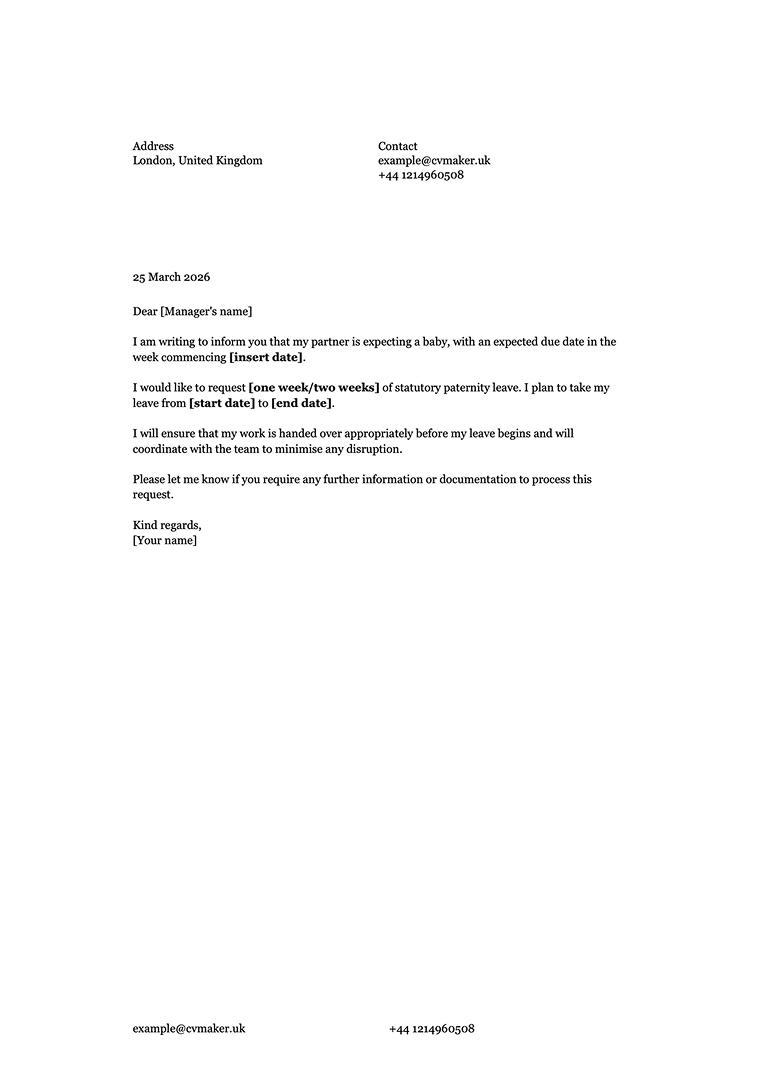
It is best to put this information in writing. Providing a clear, written record helps your HR department process your pay correctly and arrange adequate cover while you are away.
Don't miss the 15-week deadline
Even with the new 2026 flexibilities, you generally still need to inform your employer that you intend to take paternity leave by the 15th week before the baby's due date. Providing this "initial notification" early ensures your HR department has your records ready for when you're ready to book your specific dates.
Example of notification
Returning to work after paternity leave
Returning to your job after a major life transition can feel daunting. Fortunately, UK employment law provides strong protections to help you settle back in.
When you take statutory paternity leave, you have the automatic right to return to the exact same job on the same terms and conditions. If you combine your paternity leave with Shared Parental Leave and your total time away exceeds four weeks, you still have the right to return to your original job, or a suitable alternative role on no less favourable terms.
Redundancy protection
The government is strengthening protections for new parents and has announced plans to extend redundancy protections. If implemented, this would mean that, from 6 April 2026, fathers and partners receive enhanced priority in redundancy situations. For 18 months after the birth or placement of your child, your employer would be required to offer you any suitable alternative vacancy before confirming redundancy.
Flexible working requests
Balancing a career with a new baby often requires a change in routine. All UK employees now have a day-one right to request flexible working. This could mean asking for part-time hours, altered shift patterns, or remote work.
Employers must handle these requests reasonably. If an employer refuses a flexible working request, they must consult with you and provide a clear written explanation. Employment tribunals take these rights seriously. Refusing a flexible working request from a returning parent without robust justification can lead to claims of indirect discrimination.
How to address a CV gap after paternity leave
Taking an extended period off for family reasons is common and respected. If you decide to take Shared Parental Leave or an extended career break after your paternity leave, you might worry about how this looks to recruiters.
You can address a gap on your CV clearly and professionally. Simply list the dates with a title such as "Planned Career Break" or "Parental Leave". You do not need to provide personal details or over-explain your absence.
For example:
2025 - 2026
Parental Leave
Took a planned career break to focus on family commitments. Now returning to the workforce and eager to take on a challenging project management role.
Raising a child helps you develop strong transferable skills that employers value. Time management, budgeting, problem-solving, and adaptability are all highly relevant to the workplace. If your career break was substantial, highlight these soft skills in your CV summary or cover letter.
Paternity leave essentials
Duration: You can take up to two weeks of leave, split into two separate blocks within the first 52 weeks of the child's arrival.
Pay: Statutory pay is currently £187.18 per week (or 90% of earnings if lower), subject to having 26 weeks of continuous service.
Notice: You must notify your employer 28 days before you want each block of leave to start.
Future changes: In April 2026, taking the leave is expected to become a day-one employment right and you gain enhanced protection against redundancy for 18 months, subject to legislation being finalised.
Returning: You have the right to return to the same job and the right to request flexible working arrangements from your first day.
FAQs
Can my employer contact me during my paternity leave?
Your employer can make reasonable contact with you to discuss your return to work or share important company news. This contact should be minimal and respectful of your time off.
What happens to my holiday pay while I am away?
Your standard holiday entitlement continues to build up exactly as it would if you were working. Many people choose to attach a few days of annual leave to the end of their paternity leave to extend their time at home.
Do I lose my paternity leave if I take Shared Parental Leave first?
Under current rules, you must take your statutory paternity leave before you start Shared Parental Leave. However, from April 2026, this rule changes, allowing you to take your paternity leave even if you have already started a period of shared leave.
Ready for your next career step?If you are preparing to re-enter the job market after parental leave, creating a professional CV is the first milestone. Use an intuitive online CV builder to format your experience neatly, ensure your application is ATS-friendly, and confidently present your skills to hiring managers.