
How to Make a CV for a Physicist: Best Tips for Your Job Search
Writing a job-winning CV for a physicist job helps you stand out when applying for research roles, graduate schemes, or industry positions. Your CV should clearly present your technical expertise, academic background, and key projects or results.
For early-career physicists or those more experienced, structure your CV so hiring managers and applicant tracking systems (ATS) can quickly scan important sections. Using a modern CV template can also help keep your CV clear and aligned with the current industry standards.
In this guide, learn how to structure a physicist CV and highlight your work history, education, and skills to improve your CV and secure a job interview.
The essentials we cover:
How to write a strong physicist CV that UK employers expect.
Which sections to include and how to tailor your CV to different job descriptions.
How to highlight measurable research achievements and technical skills.
Tips to help your CV perform well using ATS.
How to tailor your CV for academic research roles and industry positions.
Streamline your CV writing process with CVMaker, featuring intuitive designs and advice on how to choose the best CV template.

Customise this pyhsicist CV example
Physicist CV Example
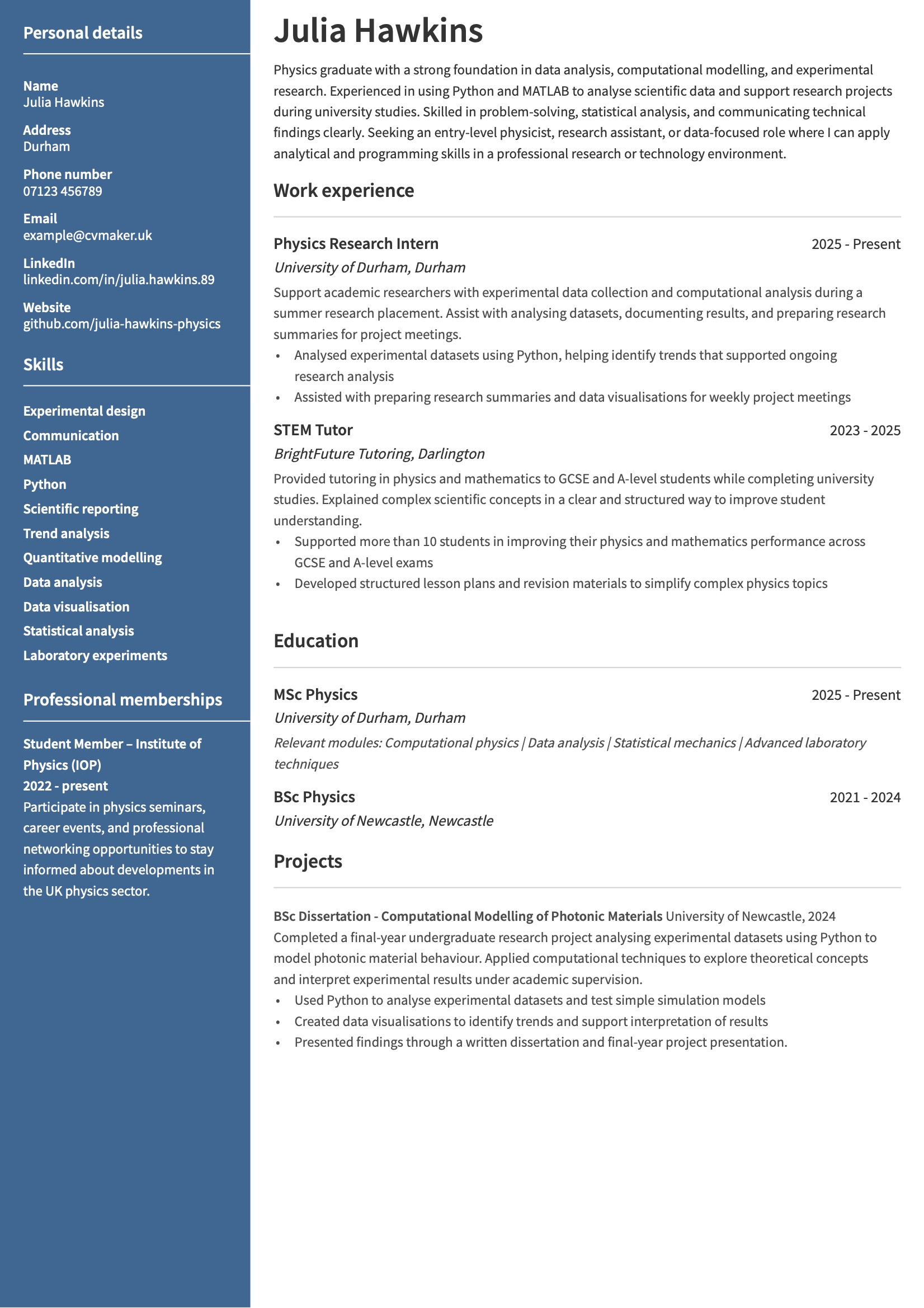
Download physicist CV example free in PDF.
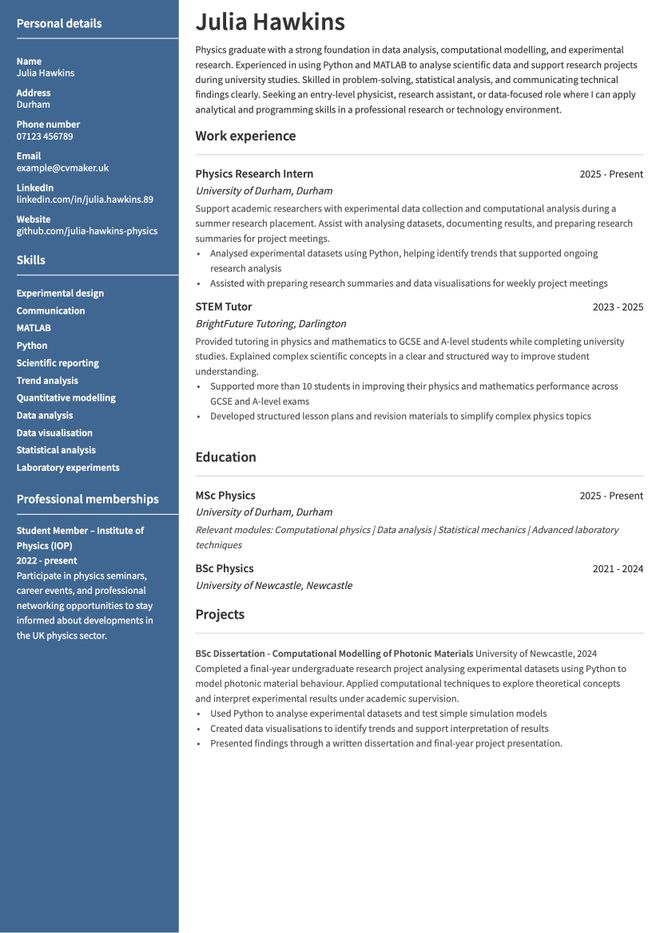
Julia Hawkins highlights a strong mix of research experience, quantitative modelling skills, and coding expertise. This Physicist CV example uses a clear reverse chronological order, measurable achievements, and relevant keywords for ATS. The professional Michigan template is concise and keeps the CV to one page, perfect for early-career physicists in the UK.
If you are starting a new career, refer to our apprenticeship and undergraduate CV examples.
What to include in a physicist CV?
To secure a role in physics or the medical sector, your CV should highlight academic achievements, technical skills, and research experience. Employers often look for candidates who have strong analytical abilities and practical laboratory or computational experience. Here’s what to include:
Contact details: It might seem obvious, but. make sure the following personal details on your CV are listed and up-to-date; Name, phone number, professional email address, LinkedIn or research profile.
Personal statement: a summary highlighting your research interests, technical skills, and career direction
Work experience: include research roles, internships, teaching positions, or relevant industry placements
Skills: highlight both technical and transferable skills such as data analysis, computational modelling, programming, experimental design, and problem solving
Education section: your degree, university, and relevant academic qualifications
Publications or projects: for academic roles, include published research or major research projects
Portfolio or research links: you may include links to GitHub, research repositories, or published work. Learn how to write a portfolio.
Memberships: joining memberships such as the Institute of Physics (IOP) or the Engineering and Physical Science Research Council (EPSRC) show commitment and can support networking opportunities.
To streamline the process, start by creating a master CV, a longer document listing all your academic and work history. You can then tailor shorter versions for specific job applications.

Must-have CV sections
Personal profile
Skills section
Work experience
Education
Learn more about how to write a good CV.
How to tailor your CV for different physicist jobs?
Employers review many applications for every physics role. If they can’t quickly see the right skills or experience, they’ll move on to the next CV. That’s why tailoring your physicist CV matters.
For academic roles, such as PhD programmes or research assistant positions, emphasise your academic qualifications, research projects, and laboratory experience. Include dissertation work, experimental methods, and collaboration with academic teams.
For entry-level and graduate roles, highlight technical skills, data analysis, and quantitative modelling. Show employers you can apply physics knowledge to real-world problems, such as data analysis, building simulations, or assisting engineering and technology teams.
If you are applying to senior or specialist positions like a medical physicist CV, focus on relevant technical knowledge, healthcare technologies, and an understanding of safety or regulatory frameworks used in medical workplaces.
Improve your skills and industry knowledge by completing relevant courses to boost your CV.
Keywords to include in a physicist CV
Recruiters often rely on ATS to scan CVs before they reach hiring managers. Including relevant keywords and phrases from job descriptions can improve your chances of being shortlisted.
Common keywords employers expect to see include:
How to list physicist skills in a CV?
Strong skills help distinguish a competitive physicist CV. Physics roles combine analytical thinking, scientific research, and technical expertise, so employers expect candidates to demonstrate both technical and interpersonal skills.
If you are entering the field as a graduate or student, focus on skills developed through university research projects, laboratory experiments, and data analysis coursework.
5 essential skills for a physicist
Data analysis: physicists regularly analyse complex datasets to identify patterns, interpret results, and support research conclusions
Experimental design: planning and conducting laboratory experiments to test hypotheses and gather reliable scientific data
Programming and modelling: many physics roles involve coding in languages such as Python or MATLAB to build simulations and analyse data
Problem solving: physicists apply analytical thinking to understand complex systems and develop solutions to scientific or technical challenges
Scientific communication: presenting research findings clearly through reports, presentations, or publications.
Use your personal profile to showcase soft skills in action
Example: “physics graduate with strong analytical and communication skills, experienced in presenting research findings and collaborating on experimental projects.”
| Hard skills | Soft skills |
|---|---|
| Python / MATLAB | Communication |
| PET/CT | Collaboration |
| Computational modelling | Problem solving |
| Laboratory experiments | Organisation |
| Scientific computing | Analytical thinking |
| Data visualisation | Time management |
Tip: include hard skills in your work experience with measurable outcomes
Example: “used Python to analyse experimental datasets and create visualisations that improved the interpretation of results during a final-year research project.”
If you are new to the field, strengthening your technical and transferable skills can improve your CV. Refer to our helpful guides on communication, must-have IT skills and how to include AI skills on a CV.
How to write a personal profile for a physicist CV
The personal profile section is a summary at the top of your CV and should give a high-level overview of why you’re a good match for the job.
Highlight your research focus, academic qualifications, technical expertise, and key soft skills in a few concise sentences. Showcase your experience with data analysis, experimentation, or computational modelling, while also outlining your career goals within research, industry, or applied physics.

Personal profile on a CV
Whether you are a student, a graduate, or a seasoned professional, a personal profile is essential for your CV when targeting the UK job market. This statement should grab the attention of employers and set you apart from other applicants.
Learn more about how to successfully pitch yourself in a personal profile.
Physicist CV personal profile examples
Medical physicist CV personal profile example
Early-career Physicist with specialised knowledge of medical imaging, radiation physics, and scientific data analysis gained through postgraduate study. Combines strong analytical thinking with attention to detail and communication skills developed through academic research and presentations. Seeking to apply technical knowledge and research expertise within a clinical or healthcare physics environment.
Graduate physicist CV personal profile example
Physics Graduate with a strong academic background in computational modelling and experimental research. Experienced in data analysis, Python programming, and laboratory experimentation through university projects and research work. Known for analytical thinking, collaboration, and clear scientific reporting. Seeking an entry-level physicist or research role where strong problem-solving and quantitative analysis skills can support scientific and technology development.
Senior physicist CV personal profile example
Senior Physicist with 8+ years of experience in experimental and computational research environments. Expertise in simulation modelling, statistical analysis, and research leadership, combined with strong collaboration and problem-solving skills. Proven track record of delivering complex research projects and communicating technical findings to multidisciplinary teams. Pursuing a role to lead advanced research initiatives within industry or academic laboratories.
Principal physicist CV personal profile example
Principal Physicist with 12+ years of experience leading multidisciplinary research teams and complex experimental programmes. Specialist in advanced modelling, large-scale data analysis, and research strategy, with strong leadership and stakeholder communication skills. Known for guiding innovation in scientific research while mentoring junior physicists and developing high-impact research outputs.
Work experience to include on a physicist CV
The work experience CV section is where employers assess whether you can apply your physics knowledge in practical environments. List your roles in reverse chronological order, starting with your most recent position.
Use powerful CV action verbs such as ‘analysed, developed, designed, modelled, implemented, tested, and presented’ to describe your responsibilities clearly.

What should each work experience entry include?
Job title of current or previous role
Organisation name or research institution and location
Dates of employment (month/year)
A concise paragraph detailing your duties
Followed by 2–3 bullet points that highlight your key achievements or measurable impact.
Learn more about the work experience section in a CV.
Physics graduates can have a varied work history across science and technology:
Research scientist
Quantitative analyst.
Good versus bad achievement examples for work history
Add unique accomplishments to your CV to stand out. Avoid vague descriptions that only list responsibilities. Instead, show measurable outcomes and research contributions.
Good
Analysed experimental datasets using Python and MATLAB, improving modelling accuracy by 20%
Designed and conducted laboratory experiments investigating material properties
Presented research findings through a scientific report and academic presentation, demonstrating clear communication of complex data.
Bad
Responsible for analysing research data
Assisted with laboratory experiments
Helped write research reports.
Physicist CV work experience examples
Physicist CV work experience example
Junior Physicist, Applied Physics Research Lab, Cambridge, 2024 - present
Contribute to experimental and computational research projects within a multidisciplinary physics team. Responsible for designing simulation models, analysing complex datasets, and supporting laboratory experiments to investigate material behaviour and physical systems. Collaborate with engineers and senior researchers to interpret results, document findings, and assist with technical reporting.
Developed simulation models using Python and MATLAB. Improved modelling accuracy by approximately 15% across research simulations
Conducted 30+ laboratory experiments and processed experimental results.
Medical physicist CV work experience example
Medical Physics Intern, Regional Hospital Medical Physics Department, London, 2024 - 2026.
Supported clinical physicists within a hospital environment by assisting with data analysis, equipment testing, and technical documentation related to medical imaging and radiation therapy systems. Gained practical exposure to healthcare technologies and quality assurance procedures used in diagnostic and treatment environments. Worked closely with clinical teams to ensure equipment performance and compliance with safety protocols.
Supported routine performance checks on 15+ diagnostic systems and maintained accurate technical records for clinical use
Analysed 200+ diagnostic imaging datasets and prepared technical summaries for supervising physicists.
Graduate physicist CV work experience example (little or no experience)
Physics Research Assistant (Student Project), University of Bristol, Bristol, 2025 -2026
Supported academic research as part of a final-year undergraduate project focused on computational modelling and experimental data analysis. Worked under academic supervision to analyse laboratory datasets, develop simulation models, and interpret experimental results. Responsibilities included processing research data, producing visualisations, and presenting findings through a scientific report and final dissertation.
Built Python data analysis scripts to process 10,000+ experimental data points
Produced 15+ data visualisations and statistical summaries to support interpretation of laboratory results for the final dissertation and academic presentation.
Once you reach the interview stage, prepare by learning how to answer competency-based interview questions and use the STAR interview technique to structure clear examples for hiring managers.
How to include education on a physicist CV
Education plays a central role in a physicist CV, especially for early-career applicants. Employers often look closely at your academic qualifications, technical training, research and scientific knowledge to see if you’re the right fit for the role.
Most physics roles require at least a Bachelor’s degree in Physics. Specialist or senior positions require a Master’s degree or a PhD.
List your qualifications, starting with the most recent, and include:
Qualification name
School, college, or university
Location
Dates of study
1–2 key achievements, research projects, or specialisations
List relevant coursework, research projects, and technical skills developed under each entry.
If you are still studying, add “in progress” after the qualification.
How to format educational qualifications
Master’s Degree
[degree title], [institution], [location], [year of graduation]
MSc Physics, University of Manchester, Manchester, 2023 – 2024. Focused on computational modelling and advanced data analysis techniques used in experimental physics research.
Bachelor’s Degree
[Degree name], [Institution], [Location], [Years completed]
BSc (Hons) Physics, University of Bristol, Bristol, 2020 – 2023. Graduated with Upper Second-Class Honours (2:1). Completed a dissertation project analysing experimental datasets using Python-based modelling techniques.
PhD
[Qualification name], [Institution], [Location], [Years completed]
PhD Physics, University of Cambridge, Cambridge, 2020 – 2024. Specialisation: Quantum Materials and Computational Modelling. Conducted independent research investigating the electronic behaviour of quantum materials using advanced simulation techniques and experimental data analysis. Published 2 peer-reviewed research papers in international physics journals Developed Python-based modelling tools to analyse experimental datasets and support theoretical predictions Presented findings at 3 academic conferences and departmental seminars.
Tips for writing a physicist CV with no experience
If you have recently graduated or have no practical experience to include on CV, focus on academic knowledge and skills. Use references to boost the credibility of your CV and explain relevant interests or projects in a good cover letter.
Here are some tips:
Highlight research projects and dissertations: final-year projects, laboratory experiments, or dissertations show your ability to apply scientific methods, data analysis, and problem-solving to real physics problems.
Use physics coursework to show expertise: relevant modules such as quantum mechanics, statistical physics, electromagnetism, computational modelling, or experimental physics help demonstrate subject knowledge and scientific training.
Show transferable scientific skills: use a skills-based CV to highlight analytical thinking, problem solving, teamwork, and scientific communication, supported by academic work experience examples from lab work, group projects, or data analysis.
Include research placements or internships: volunteering with organisations like the Institute of Physics (IOP), studentships such as IPLS 2026 or university lab projects can strengthen your CV and show practical scientific experience
Consider extracurricular activities and networking: browse societies such as the Society for Psychical Research (SPR), hackathons, academic competitions, and career fairs.
Essentials for a physicist CV
Structure your physicist CV clearly with the must-have sections listed in this guide
Present your academic qualifications and research focus clearly
Highlight practical experience from laboratory work, research projects, internships, or technical placements
Demonstrate your ability to apply data analysis, experimentation, and scientific problem-solving to real-world challenges
Include relevant tools, programming languages, and technical skills such as Python, MATLAB, or data modelling.
Dos and don’ts for a [job title] CV
Dos
Reflect the language used in job descriptions
Use bullet points to make your skills and work experience easy to scan
Quantify research outcomes to show impact and measurable results.
Don’ts
Submit the same CV for every application without tailoring it to the role
Overload your CV with technical jargon that may reduce clarity
Include long explanations that make it harder for hiring managers to identify your strengths.
Next steps?
Ready to submit your CV? Check your CV length is concise and uses clear professional fonts and colours. Check for spelling errors before sending your CV via email to recruiters. Choose a matching cover letter template and prepare for most commonly-asked interview questions.
FAQs
What is a physicist's salary in the UK?
Entry-level physicists typically earn £28,000–£35,000, while experienced professionals or specialists may earn £45,000–£60,000+, depending on the sector and level of expertise. Learn more about UK salaries in 2026 and employee benefits.
What are some early-career schemes in the UK for physicists?
include graduate schemes, research assistant roles, PhD programmes, and research placements offered by universities, research institutions, and technology companies. Learn how to write an internship cover letter and explore for more ideas
What should I include in my CV for academic positions versus industry roles?
Academic roles emphasise research experience, publications, and academic qualifications, while industry roles focus more on technical skills, applied problem-solving, and practical work experience.
How do I quantify my achievements effectively for different audiences?
Use measurable examples such as the number of experiments conducted, datasets analysed, or improvements achieved through modelling or research methods. Learn more about listing achievements in a CV.
What technical skills are most in demand for physicists in the private sector?
Employers increasingly seek physicists with expertise in Python programming, data analysis, machine learning, AI, computational modelling, and statistical analysis, particularly for roles in data science, finance, and technology sectors.